
Quick Tips #1: Customer Segmentation
Decile Analysis

I am excited to introduce a new post format to this publication which will be called “Quick Tips”. It will do exactly what it says on the tin — each one of these posts will give you a quick tip on a topic that you can read and learn about in just a minute or two.
In today’s newsletter issue, I want to dive into the topic of customer segmentation.
In B2C companies, we might segment by product type/usage, customer behaviour or demographics. In B2B environments, it could be done by client turnover, industry or geographical location.
Segmentation tends to be quite broad and basic, with key performance indicators presented as averages.
Here is a fictional data set for us to look at:
“Standard tier users” segment, $1 million revenue per annum
10,000 customers
Average usage rate: 50%
Average spend: $100 per month
This simple description is useful from a reporting perspective to get a snapshot and high-level overview of the customer segment. However, this is not practical to work with for operators who design and execute strategies, projects or campaigns.
Understanding these differences is fundamental for engaging and monetising your existing customers, so let me me show you a different way to slice and dice your customer portfolio for these purposes.
Decile Analysis
A decile analysis is used to divide a dataset into ten equal parts; each representing 10% of the volume of the customer base. Continuing with our fictional example from earlier, each decile would thus represent 1,000 customers.
We want to start categorising the data next, ranking it by value from lowest to highest. For each decile, we map “spend per month” on the X-axis and “usage rate” on the Y-axis.
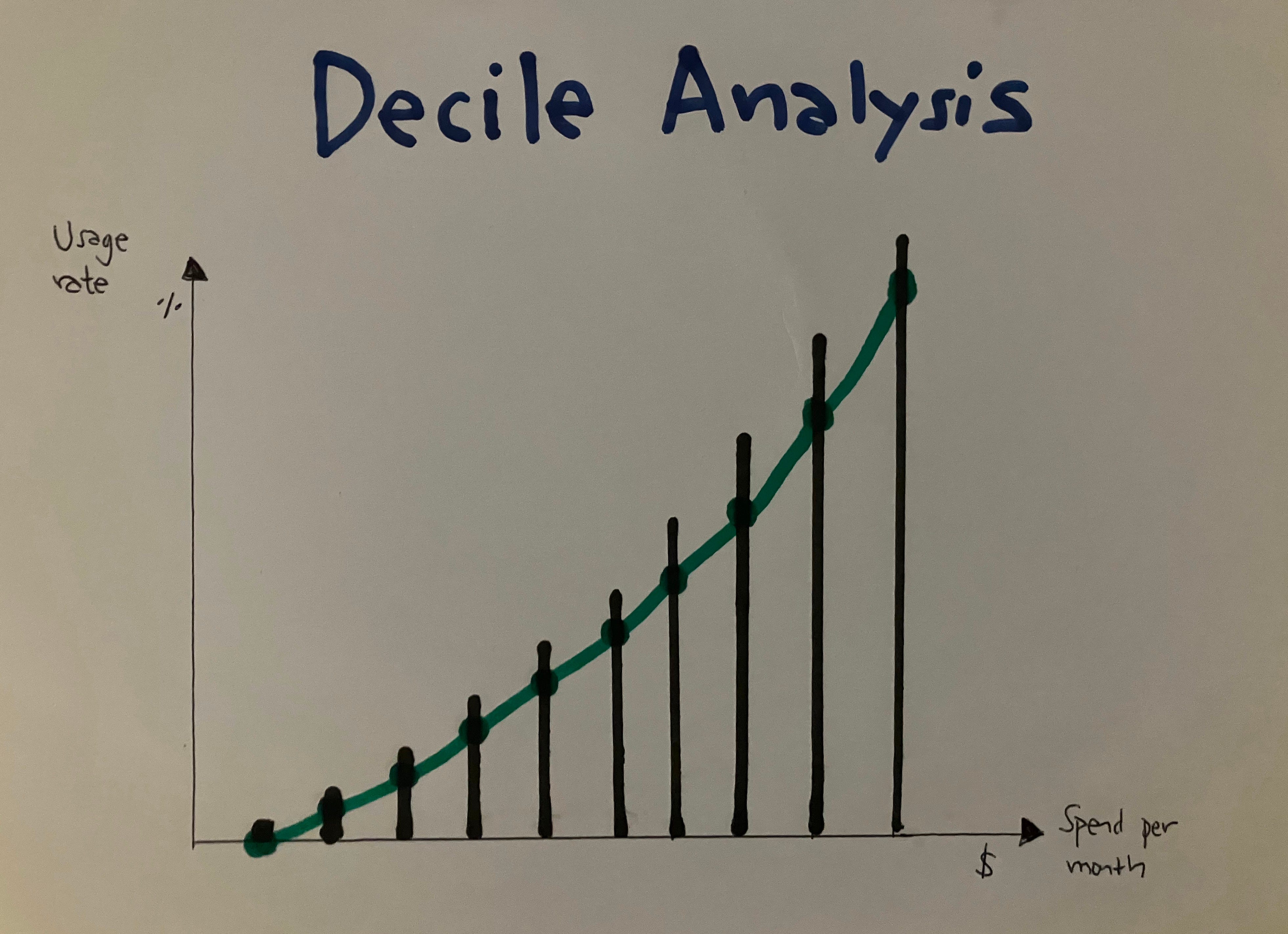
The main observation here is that the data values used earlier to describe segment performance tells us how the whole segment is performing on average, but this provides no insight into the data distribution across different parts of the segment.
This is important because as you can tell in the diagram, a different story emerges which clearly shows that there are differences in customer performance and helps us understand the reasons behind this.
In turn, this creates an opportunity to address underperforming areas and continue to expand on what is already working and performing well.
That was all for today, hope you found this useful and see you next time.
Jens
MUSICAL CODA
Great Tips from through Jens. Loving the format
People always appreciate Quick implementable strategies