
Unlocking Hidden Revenue: Demystifying Customer Lifecycle Management (CLM)
A simple guide to mastering and using CLM throughout the customer journey

Hello again!
As I was looking back at my archived posts the other day, it occurred to me that I have created playbooks, guides and deep dives on specific lifecycle stages but I’ve never discussed the entire customer lifecycle and explained in simple terms how Customer Lifecycle Management (CLM) works.
This is the topic for today’s post, so let’s jump right into the detail.
What is customer lifecycle management?
Customer Lifecycle Management is a strategy to manage customers throughout the full customer journey in a way that optimises the outcomes for both customer and company.
It is different from Customer Relationship Management (CRM), which focusses on the relationship side of things (sales, service and support interactions).
In contrast, customer lifecycle management is more holistic, data-driven and multidimensional. It looks at the performance and outcomes within each specific lifecycle stage, as well as the full end-to-end customer lifecycle.
This is more than a numbers game and CLM practitioners will need consider both ‘soft and hard’ aspects (e.g. creating a frictionless customer journey vs generating income) as part of their work.
This is not to say that CX vs Revenue are mutually exclusive — what I mean is that operators are faced with limited time, resources and budget. Therefore, it becomes a question of choice (and risk) where to focus focus and what to execute on in order to get the best possible outcome.
How does customer lifecycle management relate to customer value?
To maximise the performance of the overall end-to-end customer lifecycle, it means that each lifecycle stage needs to perform and function well.
A challenge is that business people can get overly excited and keen so they start ‘pushing’ their plans hard in order to achieve measurable and immediate results. In the world of customer value, why is this a potential problem?
I’ve previously likened customer lifecycle management to tending a garden, so I thought a good way to illustrate this challenge is by watching a short video (2:45 min) from an educational children’s television show you might have heard of.
So, what is all of this about? Well, it fundamentally relates to an agency problem between what the company wants to happen, versus what the customer actually needs.
How this misalignment looks and feels like in a business context:
It’s the new network invite on LinkedIn who says they want to connect with you because they like your content, but once connected immediately starts pitching.
Onboarding team running a courtesy call to welcome and support a new client, although the real purpose of the meeting is to upsell premium products.
Customer services keeping conversations with customers as short as possible (because they are targeted on call handling time instead of customer outcomes).
Instead of thinking ‘Inside-Out’, what needs to happen is that companies need to think ‘Outside-In’. In other words, starting with the needs of the customer and then work their way backwards to identify the right solution at the right time.
This is important because there does exist a transmission mechanism between customer value and company value, which is beautifully explained in the quote below:
“Customer will create most value for you at the point where he thinks you’re creating most value for him.”
— Don Peppers
Which are the (post-sales) lifecycle stages?
A good starting point to create a customer lifecycle management strategy is to map out what the full lifecycle looks like, and then identify the key priorities for each lifecycle stage.
Because companies tend to default much of their attention to acquiring / recruiting new customers, any post-sales activity is sometimes broadly summarised as “retention, loyalty and engagement”.
That description is very broad in my opinion, so we want to work with a clearer and structured framework for our lifecycle activities.
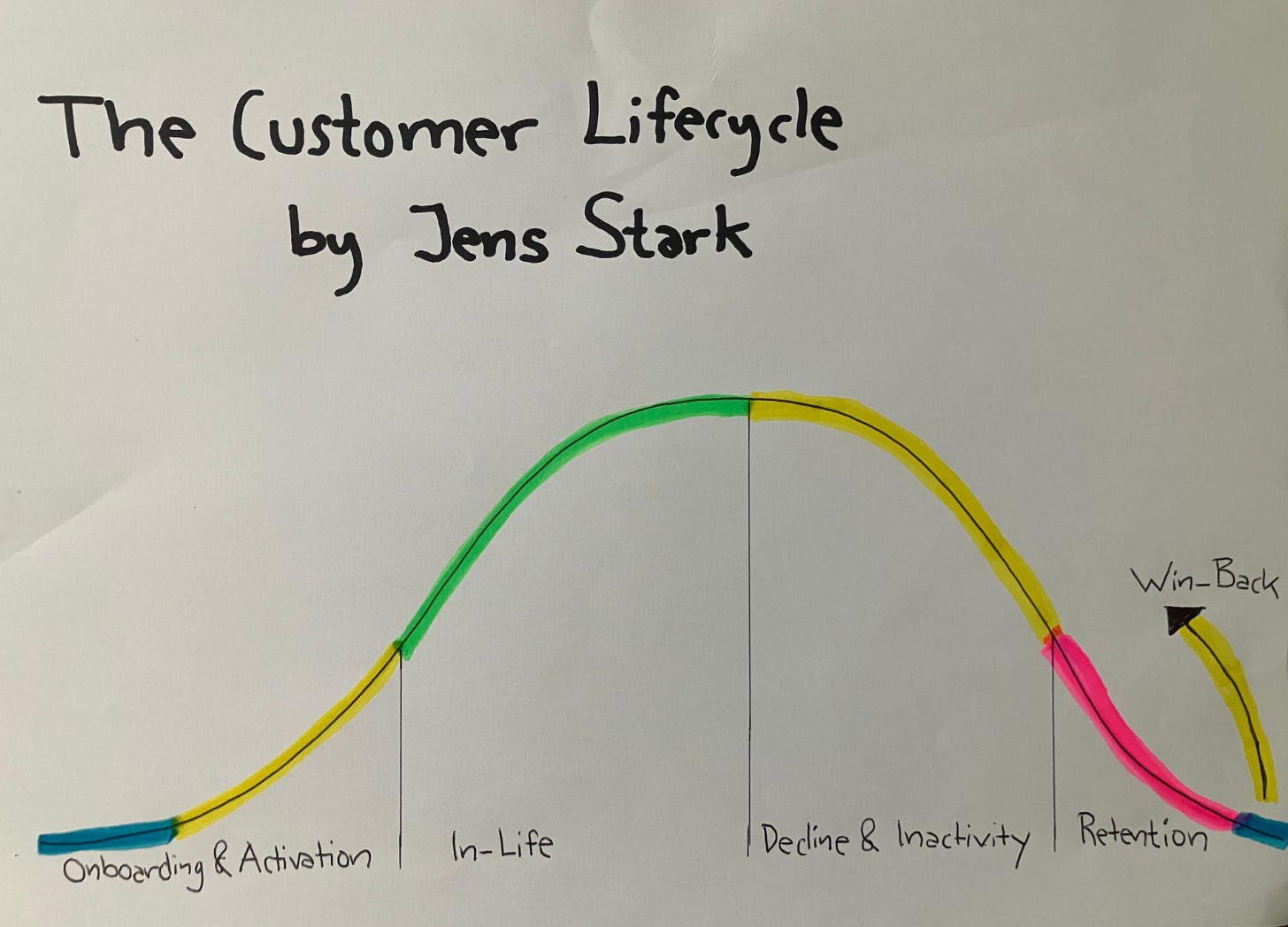
I would suggest five customer lifecycle stages to focus on for existing customers:
Onboarding & Activation
In-life
Decline & Inactivity
Retention
Win-back
The customer lifecycle is normally depicted as a normal distribution curve and it might look something like this:
Optimising customer lifecycle performance
Here is a summary of best practice and what to avoid doing:
Don’ts
Fill every monthly calendar slot with a new outreach to customers
Re-send the same mailing over and over and hoping for better results
Set a target for how much money you want your customers to make for your business and relying on promoting the most expensive / high-margin products
Teams working in silos across lifecycle stages, with no one having a birds-eye view of the entire lifecycle
Relying on average values to draw conclusions about the customer base
Do’s
Connect the dots across the customer lifecycle stages
Take into account customer experience (CX) and work towards creating a frictionless customer journey
Identify what the main priorities are for each lifecycle stage
Focus on delivering a few key initiatives that will make a material impact and ‘move the needle’.
Define one or two KPIs for each customer lifecycle stage and track performance
When it comes to customer lifecycle management, remember that “less is more”.
Reimagining the customer lifecycle
I want to conclude this newsletter post by referring back to the customer lifecycle as a normal distribution curve. This description is a realistic and accurate description of what things will look like in most companies.
There is a start, ascent, peak, decline and an end to the customer’s time with the company. This is the norm and that’s just how the story goes.
One thought I have is whether the focus on performance optimisation in customer lifecycle management limits our thinking and beliefs into ‘the art of the possible’.
What if the customer lifecycle was more of a straight line, rather than a roller-coaster?
What comes to mind is the following quote, which refers to Harley Davidson motorcycles who has a customer base with an extremely strong loyalty. The brand has become part of their lifestyle and identity, and many of them are customers for life which is interesting for CLM practitioners because of the implications on planning horizon (long-term loyalty) and customer lifetime value.
“I kind of like a business where your customers tattoo your name on their chest.”
— Warren Buffett
I love how you encourage optimising for both the customer and company. I am an engineer, turned PM, now building my own robotics company and I really struggle with selling for the sake of selling. If I believe my product is genuinely useful it’s easy to sell and talk to customers, and I think there no bigger joy than a customer being positively surprised by a new delivery.
I like how you frame CLM as connecting the dots across stages rather than just “doing more campaigns.” The focus on a few high‑impact initiatives per stage (with clear KPIs) is such an underrated unlock for both CX and revenue.