
The Customer Reactivation Playbook
A step-by-step framework to re-engage inactive customers and increase product usage

Welcome to the Customer Reactivation Playbook! This article is a step-by-step framework on how to drive customer re-activation of inactive customers in large-scale customer portfolios. We will cover the following topics:
Why managing customer inactivity is important
Preventing customer inactivity
Measuring customer inactivity
Managing customer inactivity
How reactivation relates to customer value
After studying the content in this article, you will have learned about the why, what and how to use customer reactivation strategies to re-engage inactive customers to increase product usage and revenue growth in your business.
Why managing customer inactivity is important
Many businesses will make the case for not focusing on inactive customers on the premise that it’s more effective, profitable and quite frankly — a better use of existing resources to focus on already active customers.
I don’t actually disagree with this statement. I endorse this approach. Focussing on what is already working well and reinforcing positive customer behaviours is what will scale results and move the needle on your P&L.
However, our world of customer lifecycle and portfolio management isn’t black and white. Whilst resources might be limited and you need to make choices on what to do and what not to do; you still need continuity and consistent interventions across the whole lifecycle. If you decide to “skip” a lifecycle stage, what started as a minor problem will probably show up as a major problem at a later stage.
Here are three reasons why you need a clear plan to manage inactivity:
1. Inactive volumes
The volume and length of inactive customers will start increasing up over time. Left unattended, the “inactive customer population” can become a significant number in your customer portfolio. Short-term inactivity turns into long-term inactivity. This adds costs and inertia into your business system, and will be harder to turn around the longer you leave it.
2. Flaw of averages
Beware the dangers of average metrics! Your average “income per customer” will look very different if you look at average income per active customer versus average income per inactive customer.
Similarly, these metrics will look very different once if you look apply a segment lens to these (e.g. small business vs corporate clients). Basing your customer planning on an average value for the customer portfolio as a whole can lead to the wrong conclusions about certain scenarios when you are dealing with customers with distinctly different profiles and statuses.
3. Good housekeeping
Inactivity management will ensure that the customer base stays current, relevant, engaged. Besides improving your performance KPI's, having a leaner but more active customer base is easier to manage and it will help to keep customer attrition at bay.
How to prevent customer inactivity
In the blockbuster hit Karate Kid 2 from 1986, Mr Miyagi (Pat Morita) teaches Daniel (Ralph Macchio) the ultimate defensive strategy in martial arts:
“Remember, best block, no be there.”
— Mr. Miyagi
This article focuses on how to manage inactivity (reactively), as in once a customer has already become inactive. Although, it should be noted that best results in management of inactive customers will obtained by working both proactively and reactively. That is, you will want to start thinking about this issue before the inactivity has even materialised.
Because the customer lifecycle stages are interconnected, what happens in one lifecycle stage will have a downstream impact:
If there were problems during your sales process, this will be felt at onboarding & activation.
If the onboarding & activation wasn’t effective, you will see lower product usage rates in the in-life lifecycle stage.
If product usage rates are lagging, faster spend declines and higher inactivity levels will follow.
If there is a high volume of inactive customers, many will turn into long-term inactive / dormant customers and become ‘silent attrition’.
All of this becomes a vicious circle.
Running an effective end-to-end customer lifecycle management programme is therefore really important in this respect. Try to focus on making the customer journey in the early lifecycle stages as good as it can be, and continue to optimise for a positive customer experience throughout. This will save you a lot of headaches later, and hopefully less inactivity to worry about.
Even though “driving activation” of new clients and optimising the customer journey isn’t the topic of this post, I wanted to make this point as it’s a really important one to consider in inactivity management. Get this right and it will save you a lot of headache later.
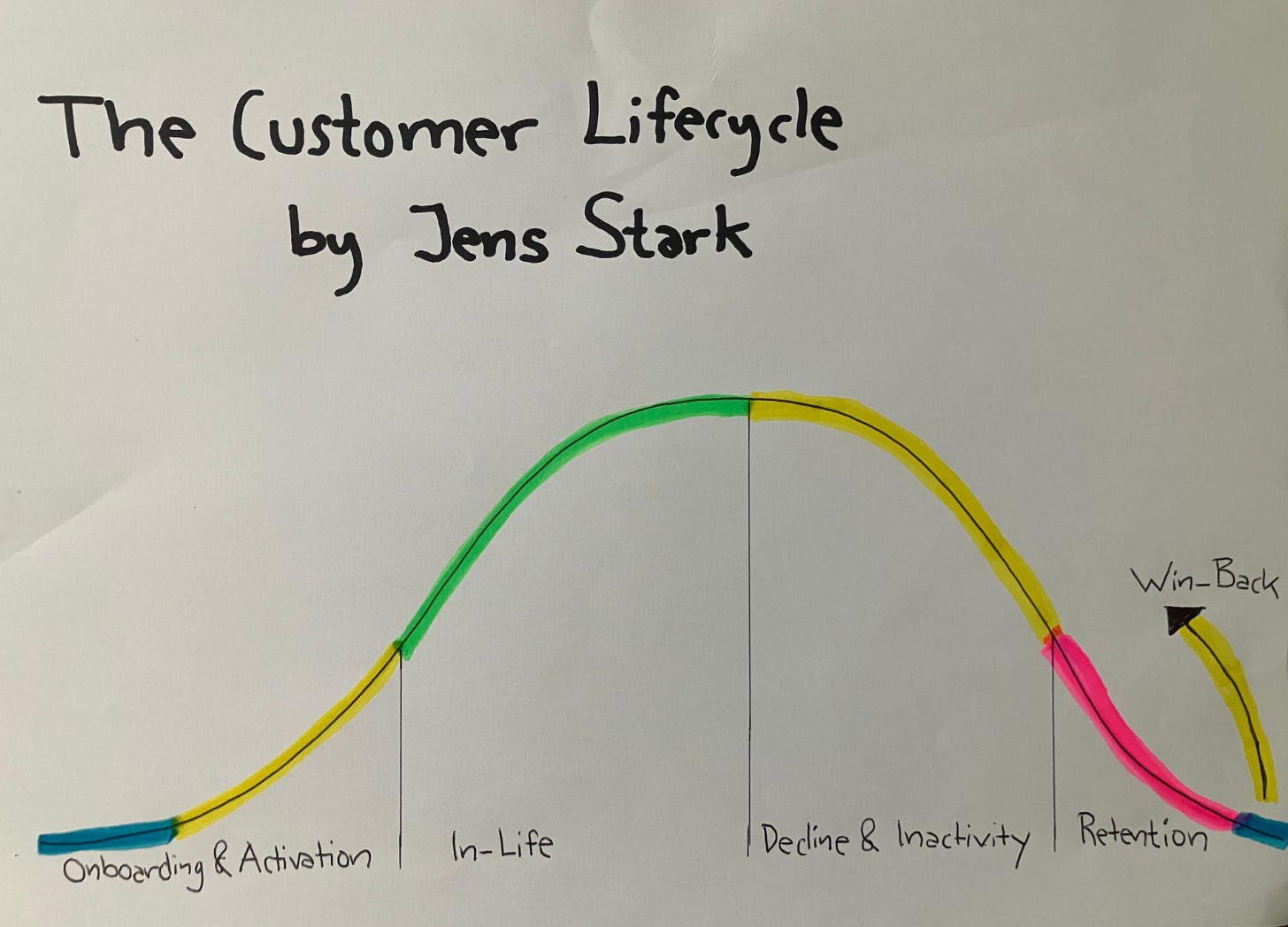
Below is a reminder illustration of the post-sales customer lifecycle, which we discussed in a previous article called Unlocking Hidden Revenue: Demystifying Customer Lifecycle Management (CLM).
How to measure customer inactivity
A good starting point for measuring inactivity is to align on a common definition for what an “inactive customer” actually refers to in your company.
People might have different assumptions about this, such as:
“A customer who didn’t complete the initial account set-up / onboarding / activation of their account”
“A customer who did complete all of the above, but they have never used their account after this point.”
“A customer who actively used the account in the past, but has not done so recently.”
Being clear and aligning on what is meant by “customer inactivity” is important, because once you start trying to address the issue you need to be certain that you are solving for the correct root-cause behind the inactivity.
You might even want to have several different definitions of inactivity, which is perfectly fine, as long as the differences are clearly understood by everyone. I would highly recommend you document these definitions in writing and socialise them with your stakeholders.
For the remainder of this article, I will use the following definition for inactivity:
“An inactive existing customer is someone who completed the account set-up / onboarding and was a past active user, but they have since changed behaviour and not used the account/product/service in the last X number of months.”
Once you are clear on your definition of inactivity, start mapping customer data to form an overview of the state of customer inactivity in your business.
In the below diagram, I have mapped three variables in the same chart:
Inactive customer value (thousands)
Length of inactivity (months)
Natural rate of reactivation (%)
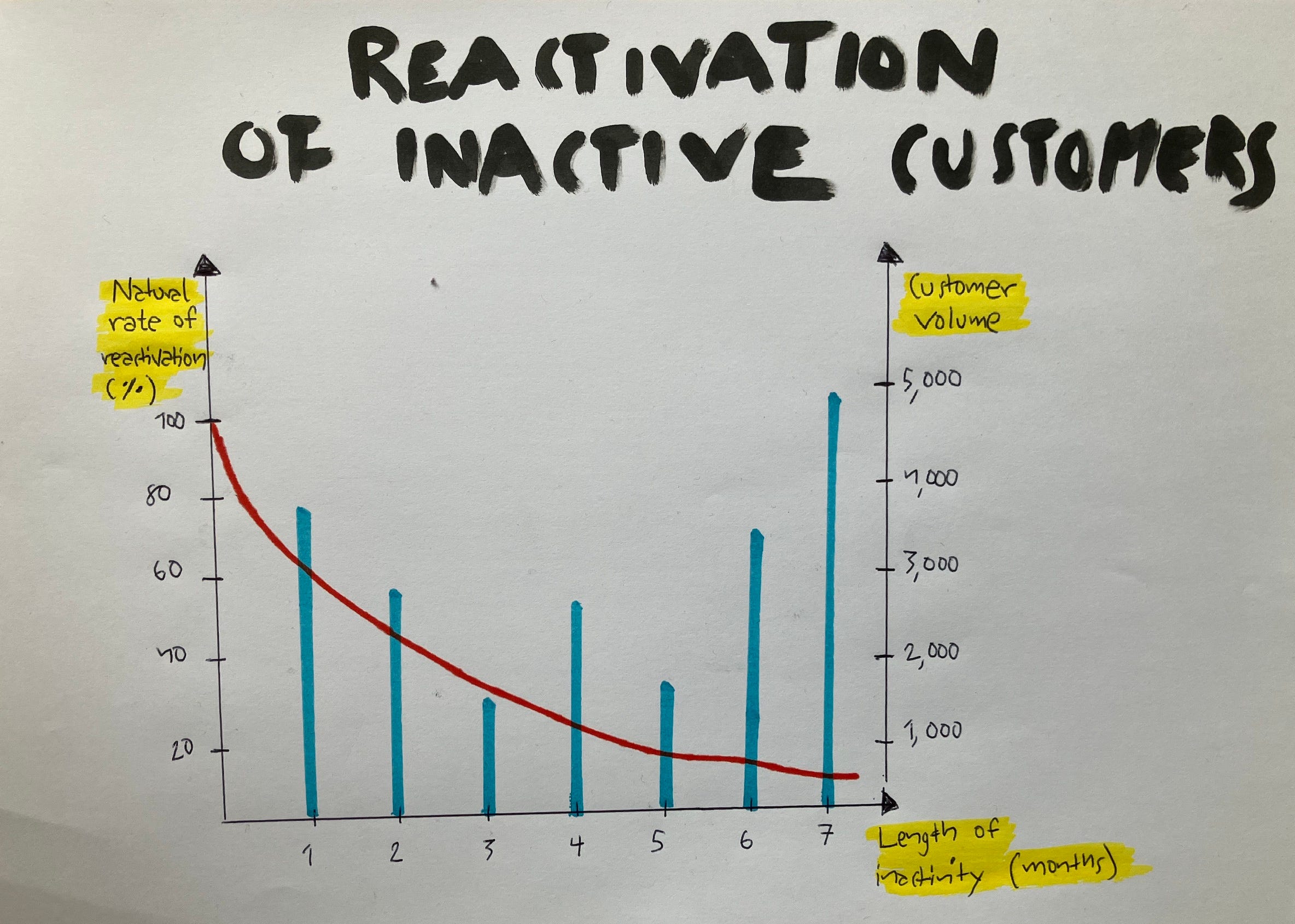
What this diagram is telling us is that the activity customer portfolio is in a continuous evolving state, particularly at the early stages of inactivity. At short-term durations of inactivity (1-3 months), many customers will naturally fluctuate between active and inactive without any business intervention.
This is what I call the “natural rate of reactivation”.
As time passes and customers remain inactive for longer, the likelihood of inactive customers to start using their account again gradually starts dropping and will eventually level out and stabilise at a very low rate.
In addition to the above data view, it’s worth taking a closer look at any outliers in your data-set. Such as, identifying high-value or high-potential clients.
Or, splitting the data set to create different views of the inactivity levels by segment type (consumer, consumer, small business, corporate, enterprise).
How to manage customer inactivity
Let’s start with what NOT to do.
A big mistake would be to follow the “spray and pray” approach and hope that your standard campaign outreach to all customers is going to resolve the inactivity situation. This might be a new sales campaign or a general newsletter update.
I often refer to these attempts as “one-size-fits-all” campaigns.
By all means, you can include the inactive population in there if you want. There’s no harm in it, just don’t expect any major results from it when it comes to inactivity management.
The main driver behind this approach mainly comes down to convenience. It’s easier for the business to execute on one single campaign for everyone and not have to think about segmentation, differentiated offers and tailored messaging. The viewpoint and pushback might be that it costs less money and takes up less resource to just run one single campaign for all customers, regardless of whether they are active or inactive.
As mentioned in previous articles, customer value is about value to the customer. Not the company.
The right approach to tackling customer inactivity boils down to understanding the customers issues and perspectives, and creating a relevant offer and communications that closely relates to the root-cause of inactivity.
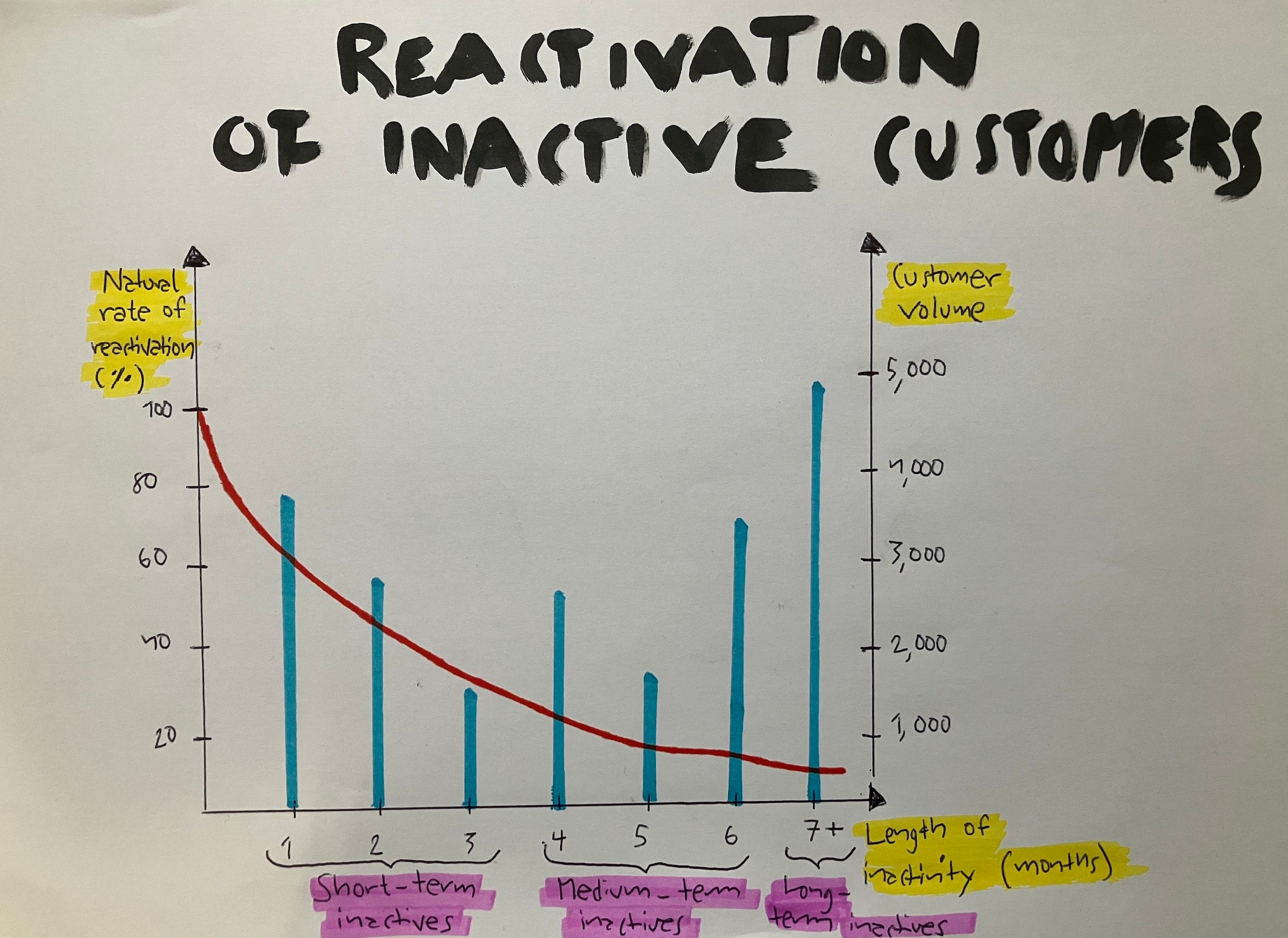
Here is a three-pronged approach to tackle customer inactivity, based on the previous data-set. I would start by dividing the inactive population into different “buckets” and develop a different reactivation offer for each, such as:
1. Short-term inactive customers (1-3 months inactivity)
Example: Emailed-based outreach. No special offer or discount, as we are expecting high natural reactivation rates from this population even without an external push to reactivate. You might want to provide a general benefits reminder to nudge the customer to start using the product again, or by “reselling” the product/service proposition you offer.
2. Medium-term inactive customers (4-6 months inactivity)
Example: Consider a strong offer (e.g. 20% price discount, double rewards or similar) and a multi-channel outreach (email + SMS reminder). You will face inertia from the customers to change their behaviour at this point, so you will need a strong and appealing customer offer to prompt the customer to act.
3. Long-term inactive customers (7 months+ inactivity)
Example: At this stage, it very much becomes a “last ditch approach” to check if the customer will stay or leave. Consider no offer or a standard offer; expect a very low response or nil response. Ultimate it becomes a question of when is the right time for forced closures and ‘culling’ the dormant users.
This last population is a tough one because chances are high that you will be dealing with a lot of ‘silent attrition’. The existing customer is still on your books, at least on paper. Mentally, they’ve left your product for good already and some might also have arranged with a different provider that they’re using, but they never told you about it.
Finally, something to bear in mind when you develop your offer and outreach approach is to carefully weigh the cost versus expected income from reactivating inactive customers.
Leveraging automation and digital when reaching out to a large volume of customers is a good idea (i.e. online and email campaigns), while saving your human-to-human outreach (such as a personal phone call or catch-up meeting) for a smaller volume of highest-value clients will help you product better campaign ROI.
How does reactivation relate to customer value?
Some businesses will use generous incentives in their efforts to reactivate inactive customers. Offering disproportionate cash bonuses or steep discounts will lead to strong response rates and uptake, but the problem with this approach is that you are going to attract (retain) the “wrong” type of customer and reinforce behaviours that don’t necessary lead to long-term value creation.
The key question you got to ask yourself is:
Why do they buy?
Why did the customer sign up to our product in the first place?
The customer was once an active user. Why did their behaviour change?
How do we fix it?
Inactivity is not the problem, it’s a symptom.
Rather than throwing money at it, do we genuinely understand the customer’s needs and wants?
If we do, how does our product/service offering measure up against this?
This is what you need to focus on and solve for.
MUSICAL CODA